What Was Happening
The printer had been working normally one week and refused to print the next. Power LED on, but accompanied by error LEDs and (on the printer’s small status screen) a “service required” or “parts inside printer need maintenance” message. The printer would not respond to print jobs from any computer.
This is a confusing failure because nothing visible is wrong. There is no jam, no out-of-ink warning, no obvious mechanical fault. The cause is almost always the waste-ink pad counter — an internal consumable that most users do not know about until the day it stops them printing.
Sound like your problem?
Bring it to our Putney workshop or message us a photo and we will give you a straight answer and a quote before any work starts.
Our Diagnosis
The “service required” error on Epson inkjets has a small number of possible causes, and the error LED pattern (or the on-screen code on models with a screen) narrows it down precisely:
- Read the error code. Different Epson families use different codes. The “waste ink pad full” code is distinctive — usually a specific LED combination or a numeric code in the ‘service’ range.
- Confirm by checking via the Epson maintenance utility (or, on some models, the printer’s own service menu). The utility reports the percentage of the waste-ink counter that has been used. When it shows 100%, the printer locks out further printing.
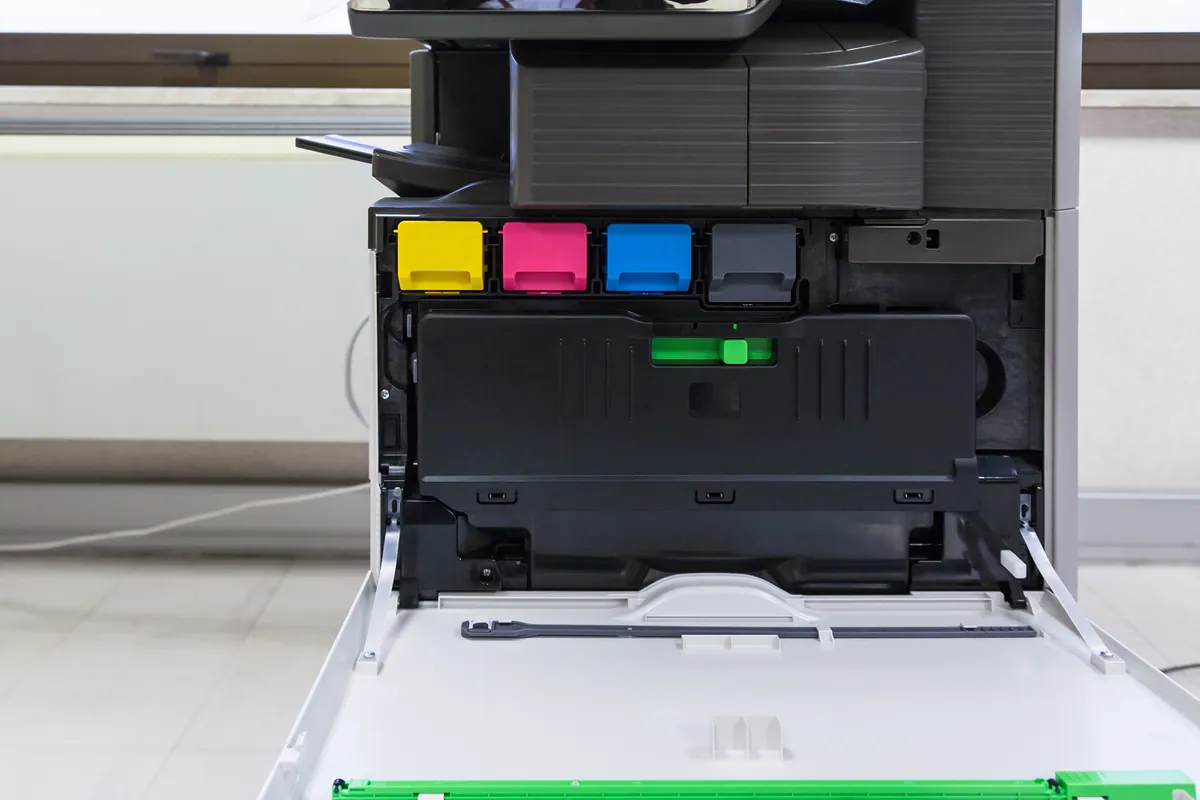
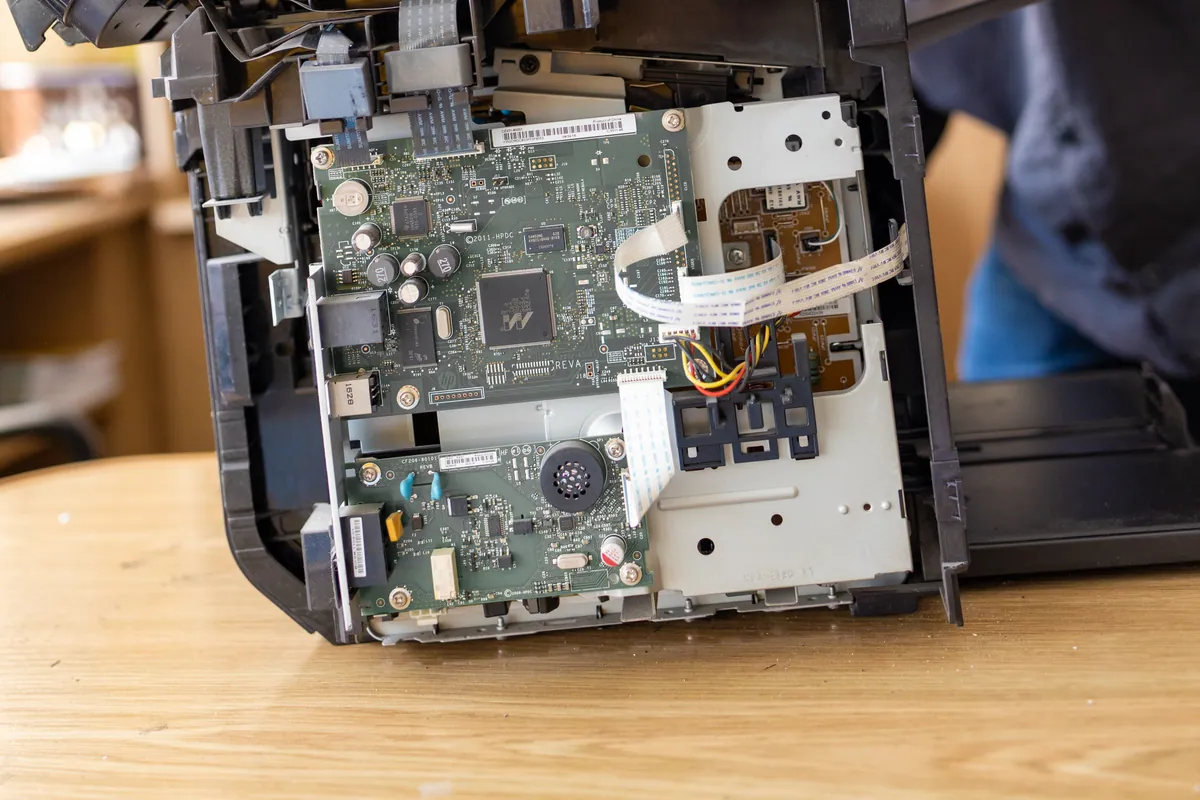
- Inspect the waste-ink pad area to confirm the physical pad is in expected condition. On most Epson inkjets the pad is accessible behind a small panel; on others it is deeper in the chassis. The visual check tells us whether a counter reset alone is appropriate, or whether the pad itself needs replacing.
For this printer the counter was at threshold but the pad still had useful absorbency left. A counter reset was the right immediate fix, with the understanding that a full pad replacement would be needed in the future.
How We Fixed It
- Reset the waste-ink counter using the manufacturer-specified service tool. The procedure varies by model; some Epson printers can have the counter reset via a key-combination at power-on, others require a USB service utility.
- Ran a test print cycle — head cleaning, nozzle check, then a full-page print — to confirm the printer responded normally and produced clean output.
- Verified all four ink-channel nozzles were firing correctly. A pad-full error is sometimes accompanied by ink-channel issues from the cleaning cycles that filled the pad.
- Cleaned the print head exterior and the rollers — routine maintenance while the printer was open.
The Result
Printer back in service, printing cleanly. Owner briefed on what just happened and what to expect:
- The counter is now reset and the printer will allow normal printing again.
- The physical pad is approaching the end of its useful life. When it is genuinely full it cannot be reset around — it has to be replaced.
- The rate of pad fill depends heavily on how often the printer performs head-cleaning cycles.
Why This Happens
Inkjet printers waste a small amount of ink every time they run a head-cleaning cycle. That waste ink has to go somewhere — and “somewhere” is an absorbent pad inside the printer chassis. The pad is intentionally sized to last the typical lifetime of the printer at average usage.
Two things shorten the pad’s life:
- Frequent head cleanings. Each manual or automatic cleaning cycle puts a measurable amount of ink into the pad. A printer that does an auto-cleaning every time it wakes up from idle (because the user prints rarely and the heads dry between jobs) fills the pad much faster than one used daily.
- Aggressive cleaning settings. Some printers offer “deep cleaning” or “power cleaning” options that use much more ink per cycle than standard cleaning.
The counter is Epson’s protection mechanism: when the pad is full, ink starts to overflow inside the printer chassis, which damages other components and can leak onto whatever the printer is sitting on. Cutting off printing at the counter threshold prevents that.
What you can do to extend pad life
- Print regularly, even small amounts. A printer used weekly does fewer auto-cleanings than one used monthly. Counter-intuitively, frequent light use is gentler on the printer than infrequent heavy use.
- Avoid manual head cleanings unless you actually have a print-quality problem. Each cleaning costs ink and counter capacity.
- Use the printer’s “quiet mode” or equivalent if available — these often reduce the frequency of automatic cleaning cycles.
- Don’t use aggressive ‘deep cleaning’ as a routine maintenance step. Reserve it for actual nozzle blockages that standard cleaning has not resolved.
- Keep the printer in a stable environment. Big temperature swings and very dry air increase head-drying, which triggers more cleaning cycles.
When to consider replacement vs repair
An Epson inkjet that has reached pad-full once is usually fine to reset. If it reaches it again within a few months, that signals the pad itself needs replacing — and at that point the economics depend on the printer:
- Lower-end consumer inkjets — replacement printer is often similar in cost to the labour for a full pad-replacement service. We’ll tell you honestly when that is the case.
- EcoTank, higher-end consumer, and small-business Epson models — pad replacement is the right call, and we can carry it out at the workshop.
Local Help in Barnes SW13
Printer faults usually fall into a small number of categories — counter resets, head cleanings, driver issues, and physical wear.
We service and repair Epson, Canon, HP and Brother printers alongside our main computer work from our Putney workshop.
Drop in to SW15, call 020 7610 0500, or contact us to discuss.