What Was Happening
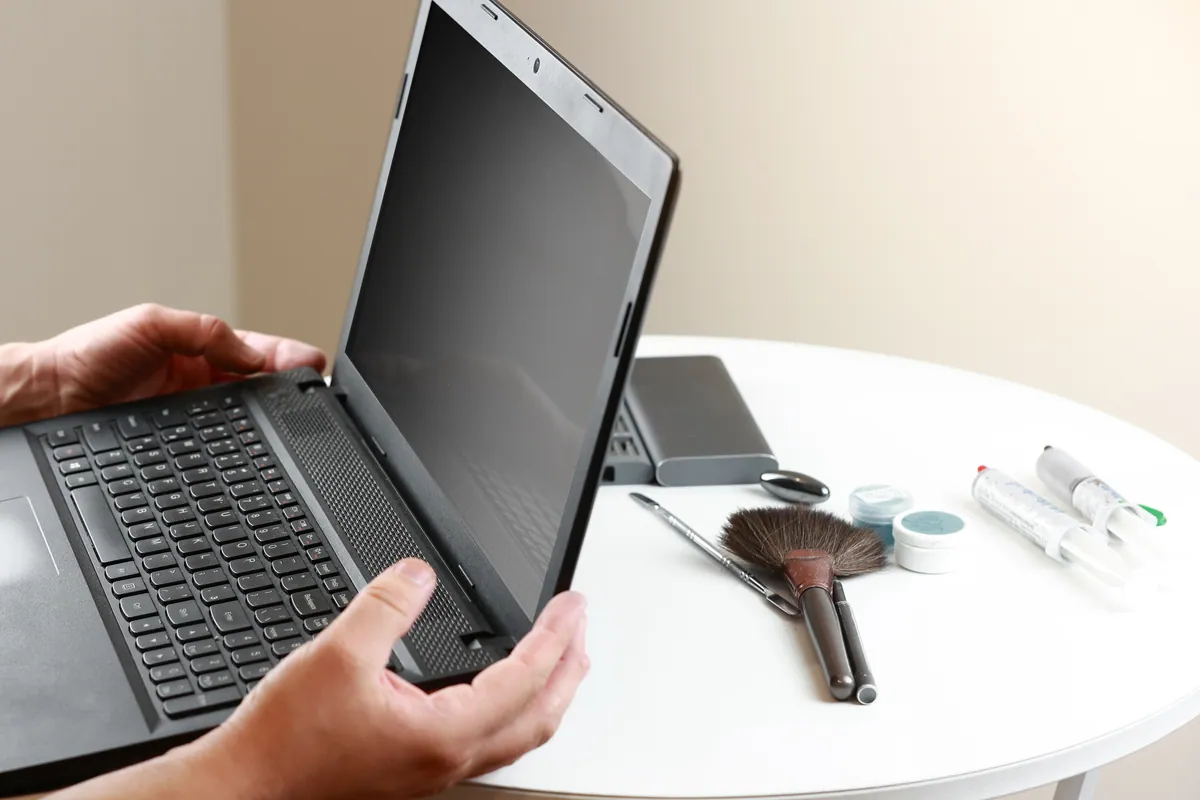
The left side of this HP laptop’s lid had begun to part company with its hinge. The right side was still doing its job, which in a way made things worse: each lift raised one corner cleanly while the other dragged behind, twisting the panel and working the break a little wider. The owner sensibly stopped opening it and brought it to us in Putney SW15 before the damage finished the job on its own.
As a computer, there was nothing wrong with it. The failure was in the box the computer lives in, at its hardest-working joint — and that distinction set the budget for everything that followed. A healthy machine with a structural injury deserves a structural repair at a structural price.
Sound like your problem?
Bring it to our Putney workshop or message us a photo and we will give you a straight answer and a quote before any work starts.
Our Diagnosis
A lid that has let go on one side hands you half the diagnosis at the door; the other half still has to be checked, in order.
What had actually failed. The hinge on a laptop is a small steel friction joint, and the steel is rarely what gives. What gives is what the hinge is anchored to: thin moulded plastic and small metal inserts inside the top lid, carrying the full force of every opening. Here the left hinge itself was in working order; the anchorage holding it inside the lid had broken free.
Whether anything expensive was involved yet. A loose hinge left to flap eventually takes the bezel, the display cable and in the end the panel with it. This one had been caught early: the break was still confined to the lid’s corner, keeping every repair route open.
What the routes actually were. Two, quoted side by side. The by-the-book fix is a replacement top lid — but a lid is a model-specific moulding, and for an HP of this vintage we could not promise one existed at sensible money. Our quote said so in as many words: a new lid, if it’s available. The alternative was rebuilding the broken anchorage with adhesive, its uncertainty priced in rather than hidden: we can try glue, and you only pay if it works.
The owner chose the glue first — the order we would have suggested anyway. Late 2020 was not a moment for spending heavily on an ageing laptop, and the attempt carried no risk: if the bond failed on the bench, nothing was owed, and the lid hunt remained as plan B.
How We Fixed It
“Top lid repaired using glue” is how the job record puts it, and those five words span the whole distance between a repair and a bodge.
The version of this fix that fails is the kitchen-table one: adhesive pushed into the visible crack, lid squeezed shut, laptop back in use within the hour. The joint never reaches full strength — structural adhesives care about clean, sound surfaces and an unhurried cure far more than enthusiasm — and gluing only the crack rebuilds the lid exactly as weak as the day it broke.
The bench version is slower and less dramatic. The lid comes apart, the failed anchorage is cleaned back to sound plastic, and the new bond is built across as much of that sound material as possible, so the force of each opening spreads into the panel instead of concentrating at the old break. The step that matters most feels least like work: leaving the joint alone until the adhesive has genuinely cured rather than merely stopped looking wet.
Only then did the hinge pull on its anchorage again, and only once the lid had been through its travel repeatedly — opened, closed, parked at angles and left there — did this qualify as “it works” under the terms quoted. It did, so it was charged; that was the deal. The repair left with our standard 90-day warranty on the workmanship, stated in plain English: a mount that gives way in normal use inside those 90 days is ours to put right; a machine dropped, sat on or forced past its stop is a second accident, and no warranty covers accidents.
The Result
The laptop went home opening and closing as one piece, on its original lid, hinges and screen, for less than the replacement-lid route would have cost — and with no promises we couldn’t stand behind. A rebuilt anchorage is a repair, not a factory moulding. Treated kindly it can last for years; we said so at handover, and the lid quote stayed on the table in case the day ever came.
This job dates from November 2020, and we won’t pretend to know where that HP is now. What we would still stand behind is the shape of the decision: two honest routes, the uncertain one priced so the risk sat with us rather than the customer, and a bond that, on the day it was asked to, held.
Why This Happens
Two things decide whether “could we just glue it?” is even a sensible question — and, between them, the fate of most broken laptop lids.
The first is the way lids break. The entire force of opening a laptop funnels through two small anchor points, and the material at those points is a few millimetres of moulded plastic, chosen for weight and cost rather than immortality. Years of cycles fatigue it, and one-handed corner opening loads one side harder than the other — which is why these failures are so often left-or-right rather than both at once. When the plastic finally lets go, the metal joint is usually still serviceable — and fractured plastic around an intact hinge is the one version of this fault glue is genuinely suited to.
The second is the parts market. A top lid fits one family of machines and nothing else, and manufacturers stop producing casework soon after they stop producing the laptop. Early in a model’s life, lids are plentiful and cheap; a few years on, supply shifts to panels pulled from scrapped machines — variable in condition and sometimes not to be had at all. This HP sat in that later window, which is why our replacement quote carried an honest “if it’s available”.
Together they produce a pattern we see constantly: a perfectly serviceable older laptop, a purely structural break, and a textbook fix that is either unobtainable or worth more than the machine. That is the gap an adhesive rebuild exists to fill. Done properly it is not a bodge — it is the proportionate repair for the corner the parts market has painted the machine into.
When glue is the right call — and when it isn’t
We will offer a glued rebuild when the break is clean, there is enough sound plastic around it to bond across, and the damage has not yet reached the screen or its cabling — and we will say up front if we think the odds are poor. On an older laptop whose lid has vanished from the parts market, it is frequently the only repair left that makes financial sense.
We will steer you away from it when the mounting area has crumbled rather than cracked, leaving nothing worth bonding to; when the lid has twisted out of true; when the display is already involved; and on a newer machine where lids remain plentiful — there, replacement is usually the better money.
Whichever side a machine lands on, we think the pricing should follow the certainty. A repair with a known outcome gets a firm price. An attempt with an honest chance of failing gets priced the way this one was: it works, or it isn’t charged.
Local Help in Putney SW15
If a laptop near you has started opening unevenly — one corner willing, the other reluctant — or a hairline crack has appeared beside a hinge, stop working the lid and have it assessed while glue is still on the menu — every cycle from here enlarges the job. We will tell you straight which routes your machine has left: a rebuild like this one, a replacement lid, or “spend the money on something newer”. There is a diagnostic fee, and it disappears into the price of whatever work goes ahead.
The workshop is on Lower Richmond Road, a short walk from anywhere in Putney SW15. Drop the machine in, or call 020 7610 0500 — the laptop hinge repair page covers the service in more detail, and our computer repair in Putney page covers the area.