What Was Happening
The display had started showing odd behaviour over a few weeks. First an occasional flicker when adjusting the lid. Then specific angles consistently produced a black screen. The customer had narrowed down which angles worked — about 100 degrees was reliable — and was avoiding the others. They knew it wasn’t a sustainable workaround.
This is one of the more diagnostic-friendly symptoms on a MacBook. A display that fails correlated with lid angle tells you almost exactly what’s wrong before you’ve taken anything apart.
Sound like your problem?
Bring it to our Putney workshop or message us a photo and we will give you a straight answer and a quote before any work starts.
Our Diagnosis
The pattern is distinctive enough that the diagnosis is largely confirmation:
- Map the angle-to-fault correlation. Opened the lid in small increments, noted which angles produced clean display and which produced fault. The pattern was consistent and reproducible — same angle, same symptom, every time.
- External monitor test. Connected to a known-good external monitor via Thunderbolt. Clean image at full resolution regardless of internal display state. GPU, display controller and external output path all confirmed healthy.
- Internal display behaviour at “bad” angles. At fault angles, the internal display either flickered rapidly, showed colour bands across the panel, or went fully black. At “good” angles, displayed normally with no artefacts.
- Physical manipulation of the hinge area. With the lid held at a normally-good angle, gently flexed the cable inside the hinge by adjusting the lid. Could induce the fault by light pressure on specific sections of the hinge channel — confirming the cable was the source.
The fault was the textbook hinge-cable wear pattern. The flex cable that carries display signals from the logic board through the hinge to the panel had developed micro-fractures in its conductors after years of opening and closing.
Why This Happens
Every time you open or close a MacBook lid, the display cable inside the hinge bends. A normal lid open-close cycle puts the cable through a small but measurable bend. Over years and tens of thousands of cycles, the metal conductors inside the cable develop tiny fractures at the bend point. Eventually some of those fractures become wide enough that contact is intermittent — and the symptom appears as angle-dependent display faults.
This is the same physical principle behind the well-known “flexgate” issue on the 2016 MacBook Pro generation, where Apple’s specific cable design failed earlier than usual. But it’s not unique to that generation — every MacBook with a hinged display has a cable that wears out eventually. The exact lifespan depends on how heavily the laptop is used (number of lid open-close cycles per day) and how aggressively the lid is opened.
How We Fixed It
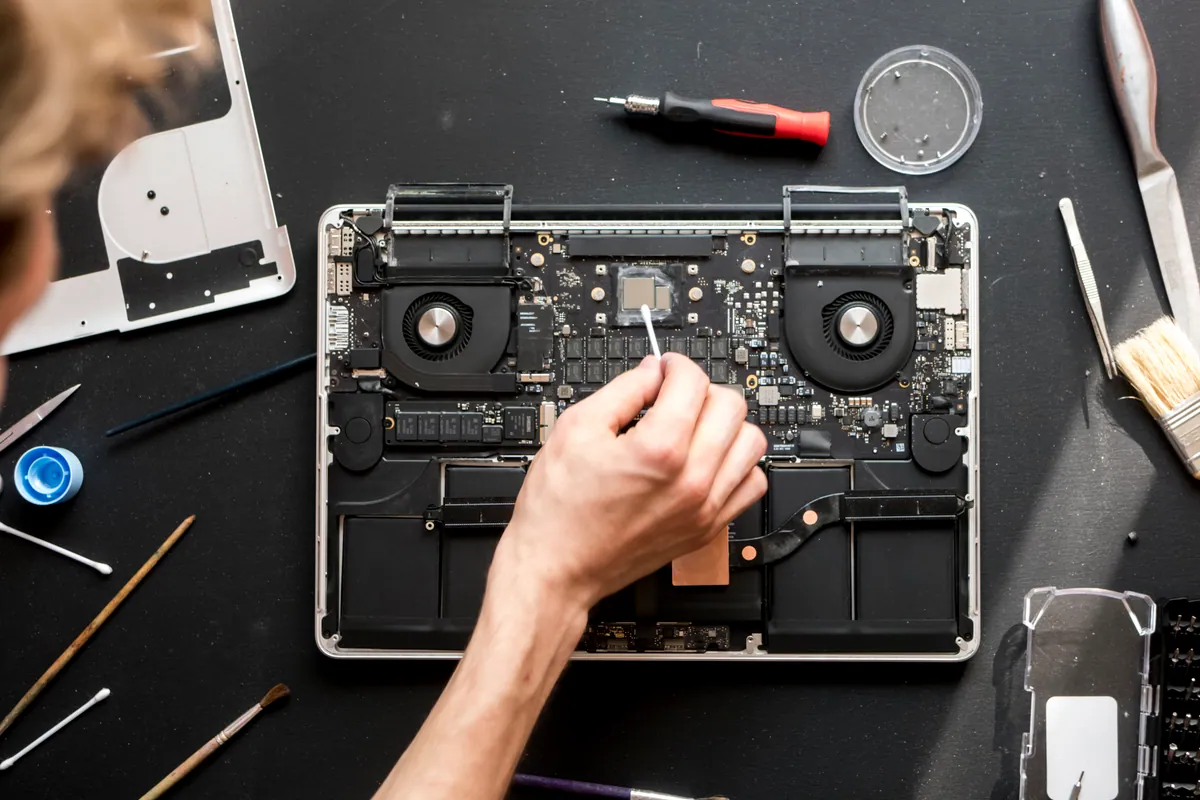
The fix on modern MacBook Pros is a full display assembly replacement, because the hinge cable is built into the assembly and not separately serviceable.
Sourced the matching display assembly for this specific MacBook Pro model. Modern MacBook Pro assemblies aren’t generic — the assembly that fits a 13-inch 2020 model doesn’t fit a 14-inch 2021 model. Correct part number matters.
Fitting:
- Powered down, mains disconnected, battery disconnected
- Hinge bolts undone, lid separated from base
- Display, camera and antenna cables disconnected from the base
- New assembly’s cables routed through the hinge channel and connected
- Hinge bolts torqued back to spec — under-torque gives a loose lid; over-torque damages the hinge mounts
- Battery and mains reconnected, bottom panel refitted
Verification:
- Boot test. Display clean.
- Walked the lid through its full angle range — every position now showing a clean image. No flicker, no blackout, no colour banding.
- Brightness range tested across full scale.
- Camera and microphone (both integrated into the assembly on modern MacBook Pros) tested.
- Wi-Fi performance verified — antennae run through the lid, so any reassembly mistake shows up as poor signal.
- Hinge tension — opened and closed several times, confirmed lid stays at chosen angles without drifting and closes cleanly.
The Result
Display clean at every lid angle. No flicker, no blackout, no colour banding. The customer can use the laptop at any position again rather than being limited to “the angle that worked”. 30-day workshop warranty on the assembly and the labour.
How to avoid this fault on your MacBook
The hinge cable is a wear item — you can’t eliminate the wear entirely — but you can extend the cable’s life:
- Don’t open the lid by the corner. Use two hands at the centre of the lid edge. Single-corner opens flex the lid asymmetrically and stress the cable harder.
- Don’t slam the lid closed. Soft close — the magnets are sufficient. Slamming flexes the cable more violently than necessary.
- Don’t carry the laptop with the lid partially open. Lid open during transport stresses the hinge cable continuously.
- Use clamshell mode if it’s a desktop replacement. A MacBook used clamshell-mode at a desk with an external monitor opens and closes the lid very rarely — extending hinge cable life dramatically.
When to bring it in vs wait
A hinge cable fault gets worse over time, not better. Symptoms typically progress through:
- Occasional flicker at random
- Flicker correlated with lid movement
- Specific bad angles, specific good angles
- Most angles bad, narrow good window
- Display fails outright
If you’re already at stage 3 (this customer’s stage), the fault won’t self-resolve and will continue to worsen. Each lid movement at this stage is additional wear on a cable that’s already failing. Earlier is cheaper than later — and at the outright-failure stage, diagnosis takes longer because the angle correlation is no longer the obvious clue it was.
Local Help in Putney SW15
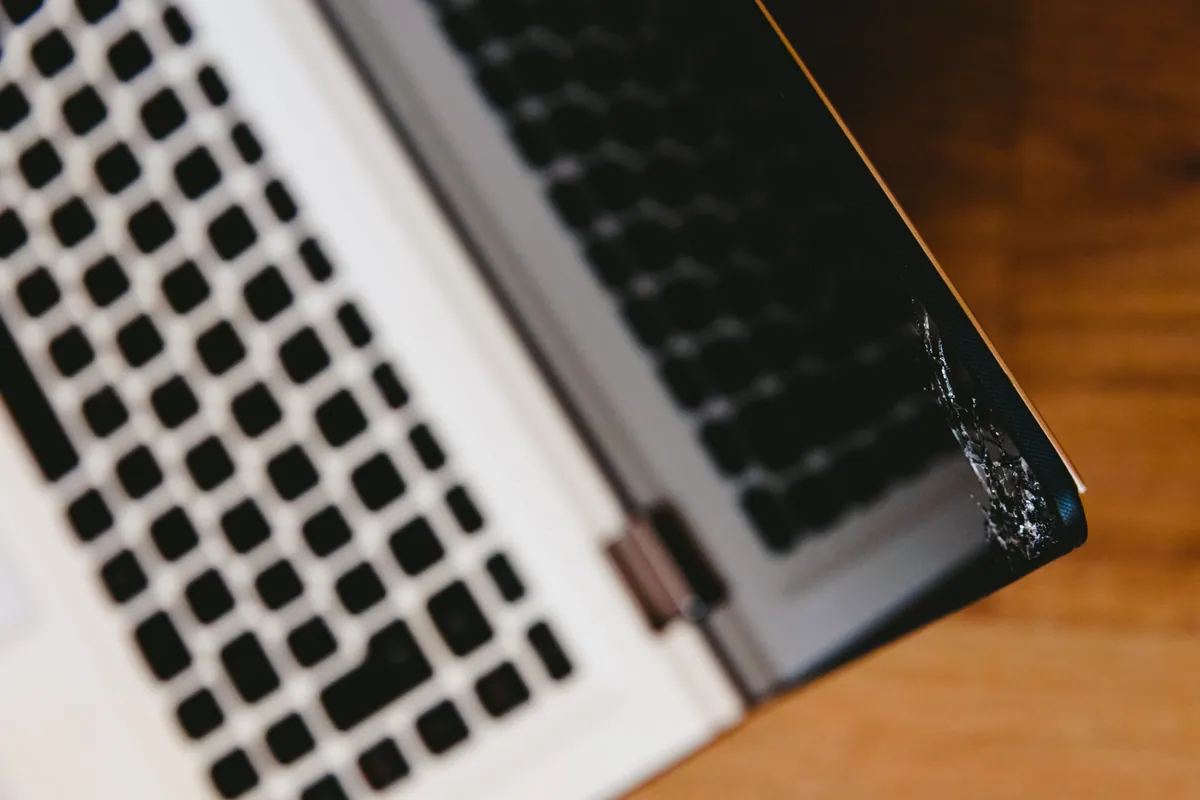
A cracked or black laptop screen is usually the panel alone — confirming that takes minutes and avoids paying for parts you don’t need.
We fit matched panels for Acer, Asus, Dell, HP, Lenovo, Samsung and MacBook models at our Putney workshop.
Call 020 7610 0500 or contact us for a quick estimate.